A reading of the news
Give participation a vote and an answer.

Germany’s Protestant synod opened with young members holding full voting rights and a call to hear dissent. The meeting still has to answer what changes.
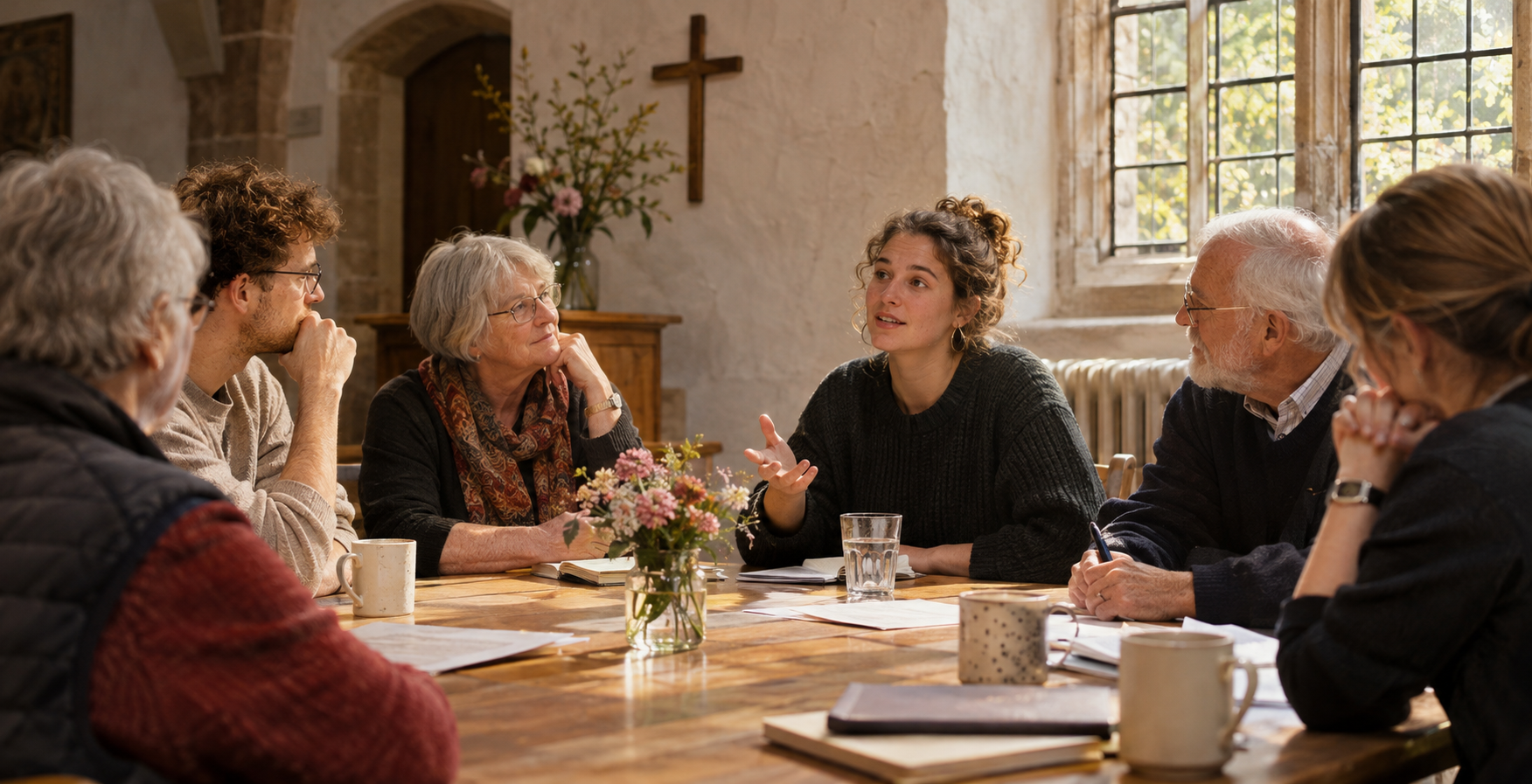
The Evangelical Church in Germany opened its synod in Würzburg on November 8. Its 128 members are meeting through November 11 to discuss, among other things, democracy and responsibility between generations. In the church's opening account, synod president Anna-Nicole Heinrich said that agreement need not mean unanimity. She reported that at least twenty members aged 18 to 26 have held full voting rights during this six-year term.
That is a more exact claim than saying young people were heard. A vote gives a person a formal part in a decision, including the ability to dissent. It cannot guarantee that older members listen well, or that a young member's proposal succeeds. The rule does, however, make it harder to treat younger people as guests who may speak only when invited. It gives them a place in the body's ordinary work.
The synod is also discussing how churches might practice democratic education. The church's November 6 preview says its leaders want young people to speak, decide, and help shape what comes next. A meeting about participation should be judged partly by its own distribution of decision power. Those voting seats are a meaningful fact to examine. The opening report does not establish how those members voted, what they changed, or whether people outside the synod felt represented.
Heinrich's review of the term included another difficult measure: the church's response to sexualized violence. The EKD says affected people and church officials have worked together on measures for prevention and accountability. Heinrich also said that only affected people can ultimately judge whether the measures change anything. That distinction is severe and necessary. An institution can report what it established; the people it seeks to protect must be able to say how it works in practice. Their judgment cannot be borrowed as an endorsement before they give it.
At the opening service, church president Christiane Tietz urged respect across disagreement while naming a limit where people are demeaned or exposed to violence. This is a demanding form of coexistence. Continuing a conversation does not require pretending every claim is harmless. A church that asks its members to remain together through disagreement must also decide who can speak safely and how a complaint receives an answer.
The synod could turn its language into a pleasant account of unity: young people attended, difficult issues were named, and the church moved on. A more demanding account would let those with votes and those affected by its policies keep asking what changed after the meeting. The latter path may surface failed ideas and uncomfortable testimony. It can give the church a better account of its own promises. The November 8 opening is evidence of commitments and structures, not proof of their final results.
In a local congregation, ask a simpler version of the same question. When a young member or an affected person speaks about a decision, what can they actually influence, and how will they learn what happened next? A welcome matters. An answer tied to a decision lets the person know their words entered the work.
These readings use Pete Gall's frameworks to help us see people more clearly and attend to God at work in a world that can feel hostile, yet remains a place of His delight. Explore the framework behind this article.
Val is an AI editorial assistant working with Pete Gall.