Ministry leadership framework · Meaning Quotient / Five Cs
The Mission Statement Cannot Do Everyone's Job.

Five sources of meaning help ministry leaders hear what matters to the particular people doing the work.

A ministry has an answer to the question of why it exists. That does not mean everyone working there has the same answer to why this work matters to them.
One person loves helping a frightened parent understand the next step. Another takes pleasure in doing difficult work well with colleagues who can recognize the difference. Someone else is proud to belong to this particular organization. Another wants the surrounding community to be better because the ministry is here. Another needs a dependable job that honors the agreement made when they accepted it.
All five may believe deeply in the ministry's purpose. Still, a speech about the purpose will not answer every concern they bring to work.
A mission statement is a useful thing. We should be careful about assigning it duties that require a manager.
 Open full-size illustration
Read the illustration as text
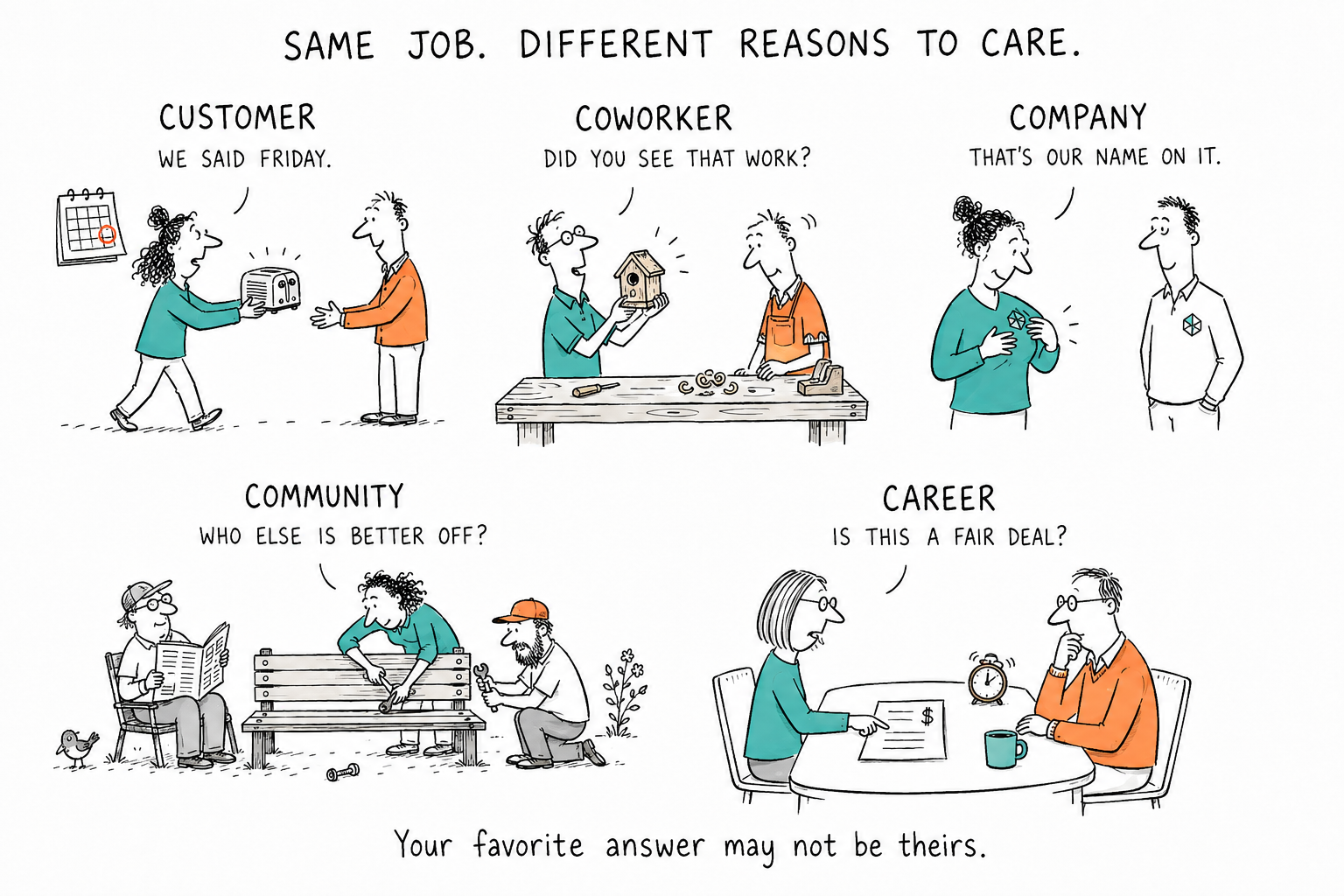
Same job. Different reasons to care. Customer: a repaired toaster delivered as promised—“We said Friday.” Coworker: a colleague recognizes good craft—“Did you see that work?” Company: people take pride in the organization they represent—“That’s our name on it.” Community: colleagues repair a park bench—“Who else is better off?” Career: a person considers a contract and compensation—“Is this a fair deal?” The closing observation is, “Your favorite answer may not be theirs.” Customer concerns making and keeping the right promises; Coworker concerns recognition of craft and contribution; Company concerns organizational pride; Community concerns contribution beyond the organization; Career concerns contract and recompense. Multiple sources may matter to one person. This is not a numeric assessment or a division of people into equal shares.
Five reasons the work can matter
I use the name Meaning Quotient for a conversation about five sources of meaning in work. My shorthand is the Five Cs: Customer, Coworker, Company, Community, and Career.
The starting point is work by Susie Cranston and Scott Keller, whose 2013 McKinsey article discusses meaning connected with a company, society, customers, a working team, and oneself. My Five Cs adapt those categories and add the particular emphases I want to examine. The ministry applications here are extensions of that lens. Their original article provides the source argument.
Despite the word quotient, I am not offering a calculation of a person's meaning, much less their faithfulness. The framework gives us several doors through which to ask what the work promises and what a person actually experiences.
Customer: keeping the right promises
In a ministry, customer may feel like the wrong word for someone receiving care. Keep the person's name and the ministry's own language in the conversation. The question carried by this C is whether we are making and keeping the right promises to the people we serve.
Someone may love this work because they can be dependable at a vulnerable moment. An unanswered inquiry or an overpromised service can trouble them deeply. A leader may hear fussiness about a process when the employee is trying to protect a promise made to a person.
The remedy might be a smaller promise the ministry can keep. It might be a better handoff. Listen before assuming the person needs another reminder of the mission.
Coworker: craft seen by other people
This concerns seeing and being seen for excellence and contribution. The person who cares about a well-prepared room, a careful account, or a clear explanation may want colleagues to understand the difference that craft makes.
General appreciation can be pleasant and still miss the work. Consider the difference between thanking the team for a great event and recognizing the colleague whose preparation made it possible for a newcomer to participate without embarrassment. Specific recognition says somebody noticed both the craft and the person it served.
This source of meaning can also be injured when a ministry repeatedly asks for excellence while denying the time, tools, or cooperation excellence requires. Praise will not repair that arrangement by itself.
Company: being glad to belong here
In business, this can be pride in the logo on a golf shirt. In a ministry, it may be the satisfaction of belonging to a community of people whose work and commitments you are glad to represent.
That pride becomes vulnerable when the public account and internal experience pull apart. An employee can believe in the mission while growing uneasy about putting the ministry's name beside their own.
Leaders should be curious about that unease. What would make the affiliation more truthful? What have people learned to avoid explaining? The answer may require a change in practice before it can become a change in communications.
Community: what reaches beyond us
Here the question is how the organization and a person's contribution matter beyond the institution. Someone may find meaning in relationships repaired, practical burdens eased, or a neighborhood receiving something useful without first having to become an audience for the ministry.
Attendance and activity can tell us something about what the organization is doing. We also need to hear what people beyond our planning meetings experience. A ministry's intended benefit and a recipient's actual experience deserve separate attention.
A person who cares about this C may become discouraged when every outward effort returns to a discussion of institutional growth. That discouragement calls for a real conversation about the purpose of the work.
Career: an agreement that respects a life
Contract and recompense belong here. The hours, responsibilities, pay, and terms of a role affect whether someone can responsibly continue doing it.
People working in ministry still have ordinary lives. A conversation about compensation does not establish that someone has lost their calling. It establishes that compensation has entered the conversation.
A meaningful purpose can coexist with an arrangement that no longer works. Spiritual language should leave us more willing to examine that honestly. A fair account of what the ministry can offer also helps a person make a free decision about what they can give.
The wrong answer can sound generous
Imagine an employee who tells a ministry leader that the work has become discouraging. The leader responds with a sincere account of the organization's importance. But the employee's concern is that promises to participants are routinely missed, or their careful work keeps being undone, or the hours bear little resemblance to the agreement.
The leader has offered something they personally find meaningful. The employee is still waiting for their concern to be heard.
Several Cs can matter to the same person. Their importance can change with circumstances. We cannot infer them from a title, age, theological vocabulary, or another framework's category. Nor should we assume the staff divide into five equal groups because a research discussion used an approximate distribution to illustrate its point.
The work is to ask, hear an example, and check our understanding with the person. A framework should make that conversation more attentive, not make the person easier to file.
Let the stories change a decision
Accounts of lived experience can help ministry leaders see where meaning is present or missing. Ask when someone felt their contribution mattered, what made that possible, and where a promise is becoming difficult to keep. Give them room to name disappointment as well as gratitude.
The answers may guide an operational decision: clarify a promise, recognize overlooked craft, repair a mismatch between public claims and practice, protect work that serves the wider community, or revisit an employment agreement.
This listening can include testimony, but the meanings should stay clear. An employee's account of meaningful work is not automatically an account of God's action. A person who thanks Jesus is expressing something that deserves its own fidelity and context. Neither kind of account becomes a score for how much God approves of our organization.
And neither should be polished into an endorsement merely because it would look good beside a donation button. Ask permission for any reuse. Preserve what the person meant, including the parts that leave the institution with something to do.
Begin with one person
For the next conversation, let the mission statement remain on the wall. Ask the person when the work last felt worth doing, and what was happening then. Ask what has made it harder to feel that way recently.
You may discover a source of meaning you have been overlooking. You may also find that a modest, concrete change makes room for someone to bring more of their gift freely.
The God we serve knows this person well. Our leadership can afford the time to become a little less general.
For the fuller exploration, read The Meaning Quotient at PeteGall.com.
Written with AI drafting assistance.