Ministry leadership framework · Kingdom Rochambeau
When Ministry Leaders Work Against One Another.

Kingdom Rochambeau helps ministry leaders understand conflict between vision, practical work, and past investment, then ask what each person can give and receive.

A ministry can gather people with vision, resources, and the ability to make something work, then spend the next several years arranging for those gifts to cancel one another.
The person who sees a possibility begins to regard practical questions as evidence of spiritual cowardice. The person who keeps the operation going wonders whether the visionary has ever been personally introduced to a calendar. The person who helped establish the place is tired of financing a conversation in which the past is always an embarrassment.
Each has something the others need. Each can also find a convincing explanation for why the others are the problem.
I call the pattern Rochambeau, after the game of rock, paper, scissors. There is a form of power with which each perspective can defeat another. People with those same perspectives can also give one another useful support. That second possibility is what makes the framework worth using in a ministry.
The aim is to love and serve particular people more fittingly. A new collection of labels to put on the staff would mostly give us another meeting.
What makes each perspective hopeful
In this framework, a Builder tends to find grounds for optimism in what has been established. Something has survived. Someone has done the work, taken the risk, assembled the resources. That history gives the Builder a reason for confidence.
An Operator tends to find grounds for optimism in what is working in the present. Can we see it? Can we account for it? Does the actual practice support the claim? A good idea becomes more credible when somebody can put it into practice on Tuesday.
An Architect tends to find grounds for optimism in a future possibility. The thing need not exist yet to make its claim. A ministry might become more faithful, more beautiful, more useful than the arrangement currently permits.
These names describe an orientation we can investigate. They do not follow automatically from a job title. The executive director may be an Architect. The person with the creative title may be an Operator. One person may take a different perspective on work and home. A single sentence rarely gives us enough to decide.
It is also worth listening to where a person's pessimism is grounded. In this model, a Builder may distrust what the future threatens, an Operator may point to a past failure, and an Architect may find the present arrangement intolerably small. The useful question is what makes the person's hope or doubt credible to them. Grammatical tense is too thin a clue.
I use this as a practical aid for forming questions and testing hunches.
How the gifts become weapons
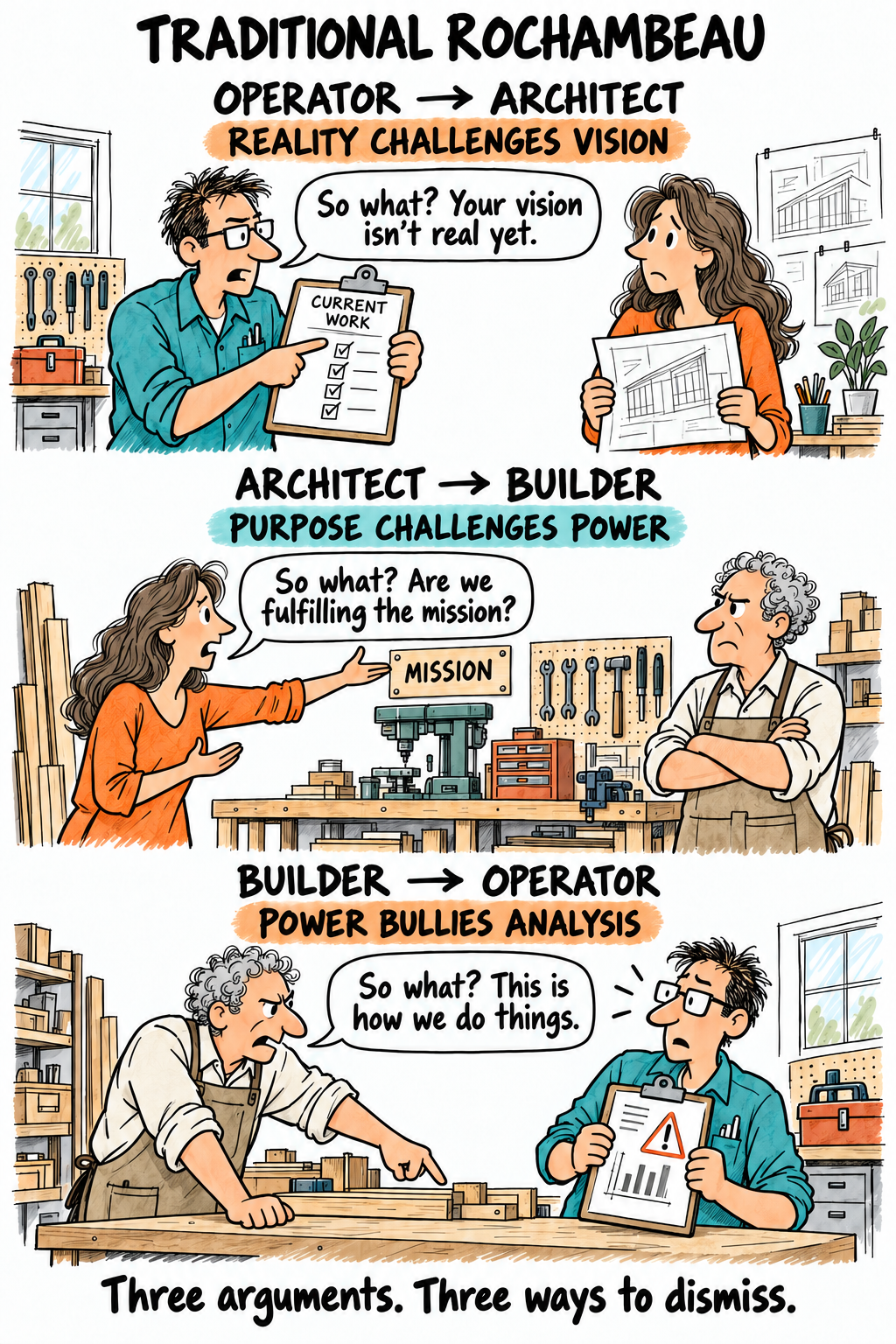
Imagine a church considering an unfamiliar form of neighborhood ministry. The Architect asks what all our buildings and resources are for if we never attempt anything beyond what we can already manage. That moral and imaginative claim can defeat the Builder's appeal to institutional history.
The Operator asks who will staff the proposed work, how the existing commitments will be honored, and what is supposed to happen on an ordinary week. Present reality can defeat the Architect's future, because an imagined ministry has not yet served a person.
The Builder can then use authority, resources, or past accomplishments to overrule the Operator's concerns. The work will proceed because the person with power has decided it will proceed.
These are recognizable moves, not a script every group must follow. A dismissive comment does not establish who prevailed, and winning does not establish who was right. Look at the actual exchange, the decision, and the person who pays its cost.
A leader can win a proposal and lose the generosity that would have made it possible. The staff follow the plan, but now the careful person has learned to keep quiet, the imaginative person is waiting for the next chance to escape, and the person supplying resources feels permanently unappreciated.
The meeting has produced compliance. The ministry still needs the gifts.
Traditional Rochambeau: using “So what?” to challenge and dismiss another perspective.
 Open full-size illustration
Read the illustration as text
Traditional Rochambeau. Three imagined workshop exchanges adapt Pete Gall’s explanation of using ‘So what?’ to dismiss another person’s perspective. Operator to Architect—reality challenges vision: the Operator points to current work and says, ‘So what? Your vision isn’t real yet.’ Architect to Builder—purpose challenges power: the Architect points to the mission and says, ‘So what? Are we fulfilling the mission?’ Builder to Operator—power bullies analysis: the Builder overrides the Operator’s warning and says, ‘So what? This is how we do things.’ The closing line reads, ‘Three arguments. Three ways to dismiss.’ The scenes show present reality challenging a future proposal, purpose challenging established practice, and authority overriding analysis. Each claim still needs to be examined on its merits; dismissing a person and defeating their argument are different outcomes.
What each person can give and receive
Kingdom Rochambeau begins when we ask what each perspective can give and receive.
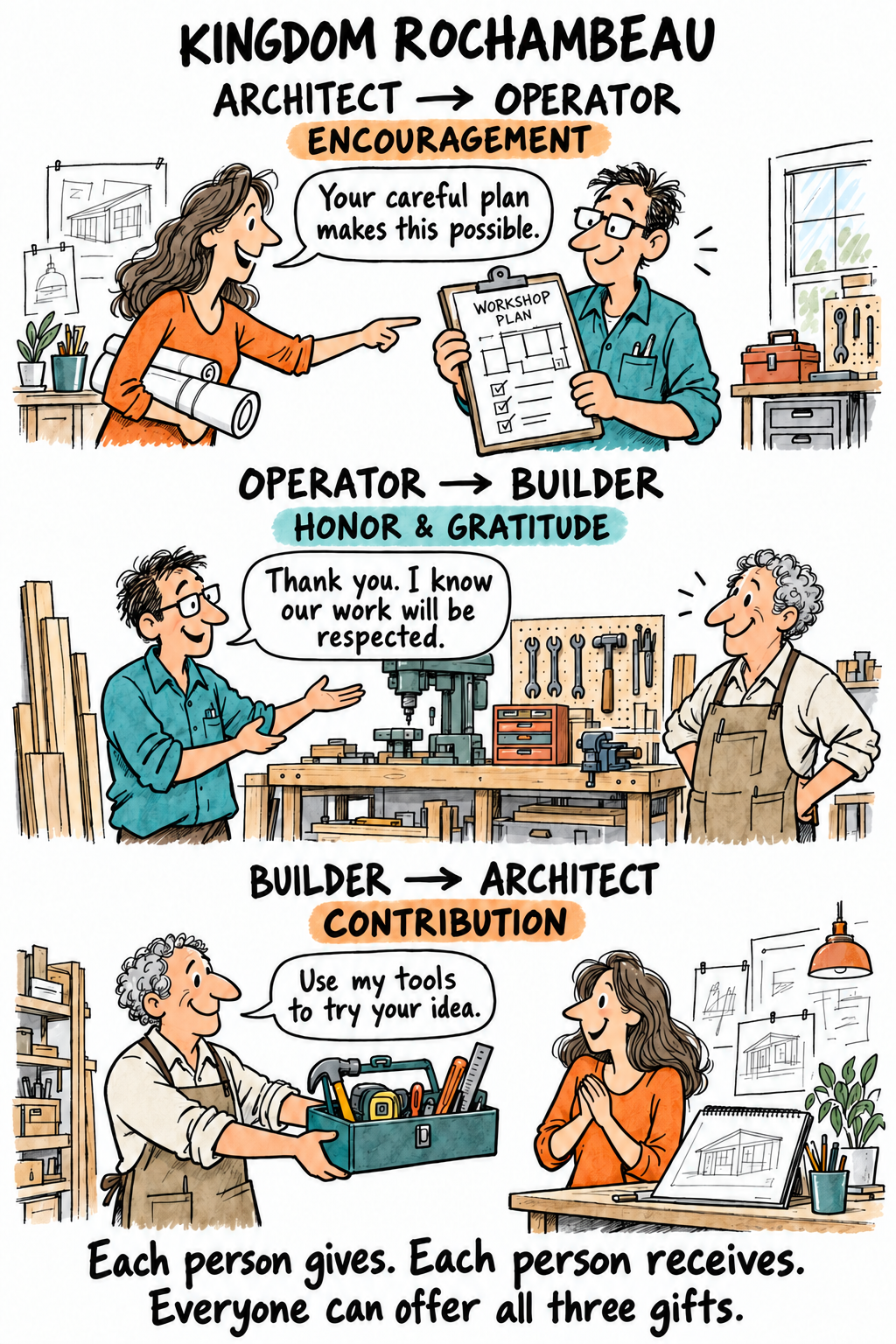
An Architect can give an Operator encouragement: a truthful account of what this careful, persistent work is making possible. The Operator needs to be seen as more than a person who prevents mistakes. Imagination can help reveal the significance of work that has become ordinary to the person doing it.
An Operator can give a Builder honor and gratitude: specific recognition of what the Builder's effort and contribution have made available to others. Honor has substance when it names something real. Flattery is easier to distribute, but it requires everybody to agree not to inspect it.
A Builder can give an Architect contribution: resources, practical support, access, or experience that helps a worthy purpose take form. The gift helps the recipient pursue the purpose while leaving them responsible for their decisions.
Receiving belongs in the picture too. An Architect who cannot receive contribution may force a useful idea to remain a private grievance. An Operator who cannot receive encouragement may keep asking control to supply the security relationship could offer. A Builder who cannot receive honor may continue trying to extract repayment from people who never understood the debt.
We can ask whether these descriptions fit the person's experience. Offer useful help without requiring them to disclose painful experiences.
Kingdom Rochambeau: encouragement, honor, and contribution support one another.
 Open full-size illustration
Read the illustration as text
Kingdom Rochambeau. Three imagined workshop exchanges show giving and receiving. Architect to Operator—encouragement: the Architect recognizes a careful workshop plan and says, ‘Your careful plan makes this possible.’ Operator to Builder—honor and gratitude: the Operator says, ‘Thank you. I know our work will be respected.’ That gratitude recognizes stable, trustworthy conditions in which diligent effort can be offered with confidence it will not be squandered or abused. Builder to Architect—contribution: the Builder offers tools for the Architect’s proposed workshop and says, ‘Use my tools to try your idea.’ The closing lines read, ‘Each person gives. Each person receives. Everyone can offer all three gifts.’ Architect, Operator, and Builder describe ways of finding grounds for hope. These are natural affinities; people can give and receive all three gifts, including with someone of the same orientation. Encouragement names something real, honor recognizes actual contribution, and practical help supports the recipient’s purpose and agency.
Generosity keeps the other person's agency
The natural pattern is encouragement from Architect to Operator, honor from Operator to Builder, and contribution from Builder to Architect. All three forms of giving are available to everyone. Two Architects can serve one another. An Operator can contribute. A Builder can encourage.
In the imagined neighborhood ministry, the Architect might first ask the Operator what would make the proposal responsible, then recognize the care expressed in those answers. The Operator might name the opportunities made possible by past investment while explaining the present constraints. The Builder might fund a bounded experiment whose purpose and limits the group can actually understand.
That could produce a different decision. It might also produce a decision to wait. Generosity does not require a yes to every proposal, and contribution is not measured only in money. A clear limit, offered without contempt and received without retaliation, can protect the people and the work.
Watch what the gift permits the recipient to do. Encouragement that pressures someone to work without rest, honor that buys silence, and money that commandeers a calling have borrowed the vocabulary while changing the exchange.
What leaders can listen for
After a project, invite people to describe what helped them contribute, where they felt understood, and what became harder than it needed to be. Listen for answers you did not expect.
A story of someone receiving timely help can reveal a relationship worth tending. A story of quiet resentment may reveal work nobody agreed to do. These accounts can inform a decision without becoming a machine for assigning everyone a type or producing favorable stories for the annual report.
Use the framework to decide how to help the person you are working with. Perhaps the visionary needs contribution. Perhaps the donor needs an honest account of what their gift enabled. Perhaps the meticulous colleague needs somebody to notice the people who have been spared trouble because the work was done well.
God has given people particular gifts. There is pleasure in discovering how much more those gifts can do when they are free to serve one another.
For the fuller exploration, read Kingdom Rochambeau at PeteGall.com.
Written with AI drafting assistance.