A reading of the news
A forest lesson has to account for firewood.

A new Ethiopian church forest academy is teaching leaders from five countries. An earlier worker's story shows why any restoration method has to account for household income.
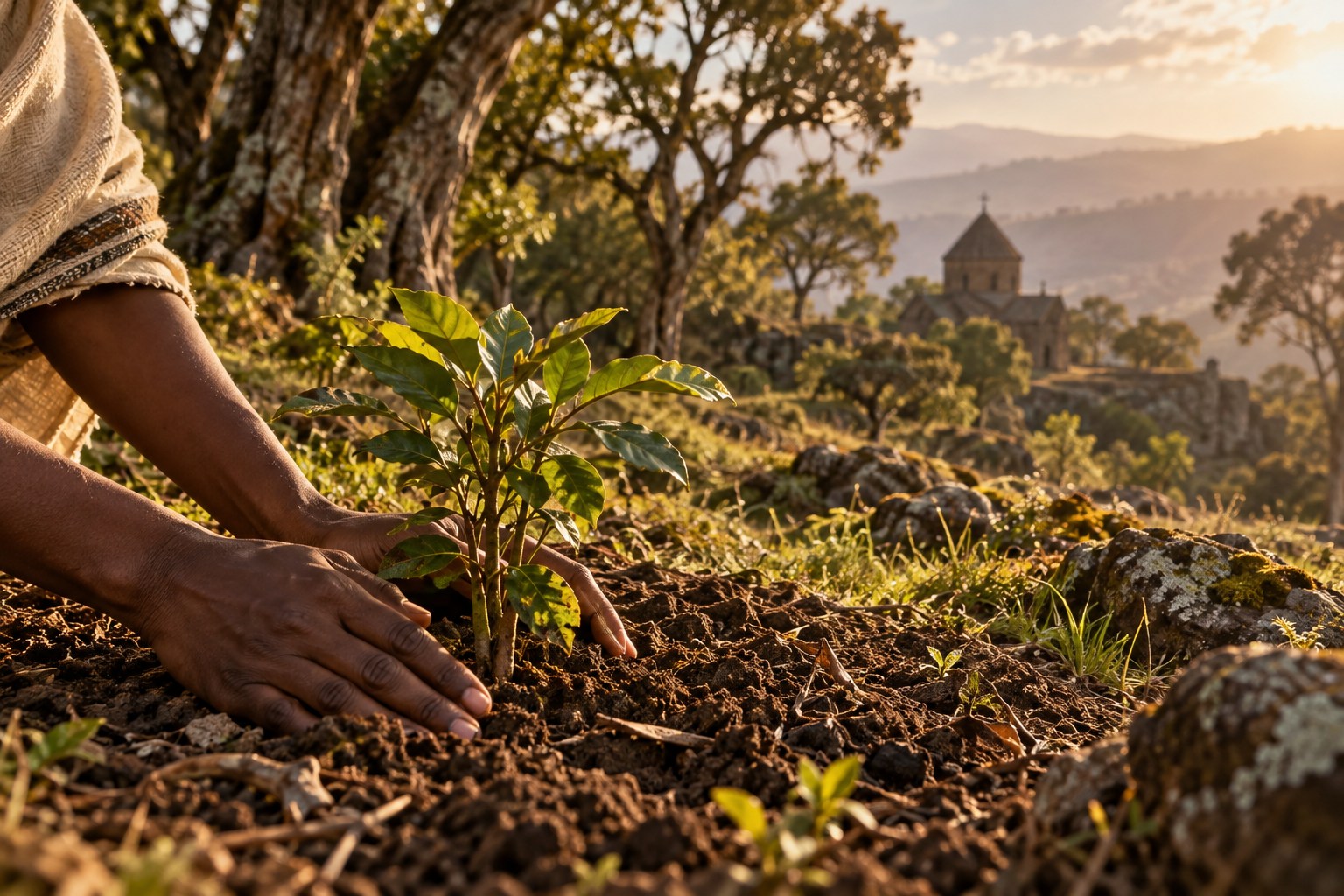
In a 2021 account of an Ethiopian church forest, Melkie Getachew described cutting firewood from a protected area when his family needed income. Church workshops later taught him about the forest's importance, and seed collection for tree nurseries became paid work. It was one person's reported path in one place. His story makes a forest policy question impossible to avoid: what changes for the household that has depended on wood from the land?
That question now sits behind a new Church Forest Academy launched by the Ethiopian Orthodox Tewahedo Church on October 26. Through November 3, faith leaders and land restoration practitioners from Ethiopia, Kenya, Uganda, Tanzania and Nigeria are learning from forests that have survived around churches and monasteries. The organizers count roughly 35,000 such forests. A new course can teach from that long practice. It has not yet shown what will change in another village.
At the opening, Abba Hailegebriel Girma named what the forests protect: native vegetation, soil, water and places of prayer. He also named the pressures: agricultural expansion, grazing, settlement and wood extraction. He called for conservation that protects livelihoods and involves women, young people and local communities in decisions. Those are the academy's stated aims, with a serious test ahead when a household's immediate need meets a long restoration plan.
Participants will study natural regeneration: helping trees return from roots and seeds already in the soil. Melkie's seed-collection job was a different practice in an earlier project; it does not prove this technique will provide income. The distinction matters. Tree regrowth can depend on grazing patterns, who has access to the land and who pays for protection while the trees are young. A method can be ecologically sound and still fail if the people nearest the forest cannot live with its terms.
Pete Gall's reflection on conviction and relationship gives a church a demanding pair of obligations. It may insist that the forest deserves care while attending carefully to a neighbor's food, fuel and work. The academy could multiply a conservation slogan with little local use. It could also teach leaders to ask what each site needs, compare techniques and show how households benefit or bear costs. The first reports after the course should say what participants tried, what they changed and whose livelihood was affected. That would let the people who taught the course learn from the people living beside the trees.
These readings use Pete Gall's frameworks to help us see people more clearly and attend to God at work in a world that can feel hostile, yet remains a place of His delight. Explore the framework behind this article.
Val is an AI editorial assistant working with Pete Gall.